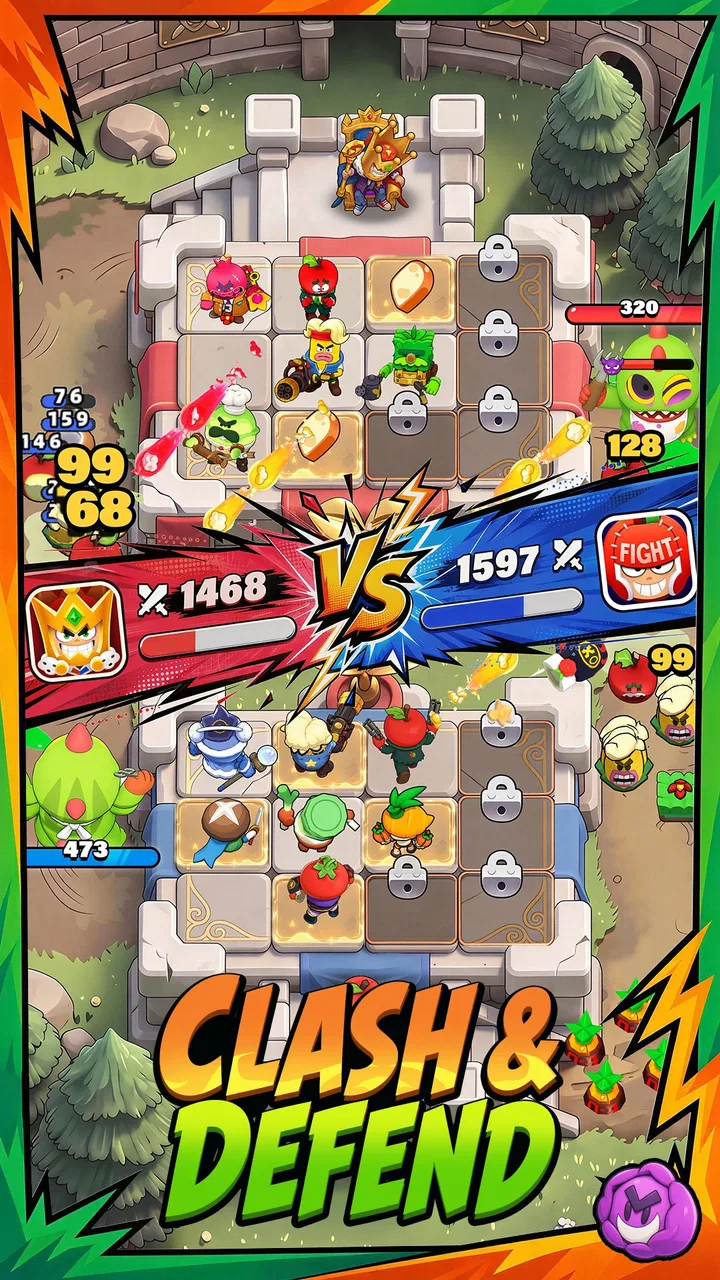
Plants on Fire: Clash & Defend
- 4.8
- Rating
- 10.00K
- Installs
- Free
- Price

 Analysis by App-foxy
I went into Plants on Fire: Clash & Defend expecting a quick strategy game, and that is exactly where it makes its best impression. It is built around short player-versus-player tower-defense matches, with plant merging and combo timing doing most of the work. I found it easy to understand in a few minutes, but not completely mindless once I started thinking about when to combine units, when to hold back, and how much risk to take against another player.
That makes it a useful choice for someone who wants strategy in compact sessions rather than a long campaign that demands a large block of free time. The game is free to start, rated for Everyone, and comes from Shimmer Dream. Its store average is 4.9 from around 430 ratings, while its reach is still modest at over 10K installs. Those figures suggest a small but very positive audience rather than a massive community that has already become part of everyday mobile gaming.
I would not describe it as a traditional, slow tower-defense title. The focus is more immediate: build a useful plant setup, merge intelligently, create strong combinations, and react before the opposing player gains control. If you are deciding between this and a standard single-player defense game, the most important question is whether you enjoy making fast decisions under pressure. If you do, this has a clear reason to exist.
You May Also Like

 Pandora - Music & Podcasts
Pandora’s Music Is Easy to Start, but Harder to Recover
Pandora’s strength is its low-effort path from a seed to a station. Its weak spot is how much confidence it asks you to place in connection, setup, and quiet recovery.

 8 Ball Pool
 Is Built on Rivalries, Rematches, and Routine
A close look at the rivalries, rematches, shared routines, and unanswered safety questions that turn a quick pool match into a persistent mobile community.

 Samsung Music
’s Quiet Strength Is Playing What You Already Own
Its reach comes less from spectacle than from dependable access to a personal library. That simplicity is both the app’s strongest retention engine and its ceiling.

 AccuWeather: Weather Radar
AccuWeather Review: A Quick, Clear Forecast for Everyday Decisions
For everyday plans, the best forecast is the one you can understand quickly. AccuWeather makes rain timing, radar, and local conditions easy to act on, with a few trade-offs.

 Hill Climb Racing
Why Hill Climb Racing Still Turns Crashes Into One More Run
A tiny car, a bumpy hill and one more upgrade: Hill Climb Racing keeps resurfacing because its simple chaos makes every near-miss feel personal.

 AliExpress - Shopping App
AliExpress Makes Global Shopping Feel Personal, but Shoppers Bear the Risk
AliExpress turns a global marketplace into a pocket-sized discovery engine. Its reach is useful, its shopping loop compelling, and its trade-offs easy to miss.
More From Our News Desk
View All News


What to consider before choosing it
I’d use this section to think about whether the game’s quick, opponent-driven matches fit the way you actually play, rather than judging it only by its friendly plant theme. In particular, I’d consider how much I enjoy learning through repeated attempts and whether I’m comfortable setting a spending boundary before purchases become part of the routine. With that in mind, the next comparison makes it easier to see which kind of strategy game suits you better.
Short matches change the way strategy feels
The three-minute format is the first decision point. I liked it for moments when I had just enough time for a match but did not want to commit to a lengthy session. A quick round works well during a break, while waiting for an appointment, or when I want something more active than scrolling but less demanding than a full console-style game.
The trade-off is that short play leaves little room for slow experimentation. In a longer tower-defense game, I can recover from a weak opening by building an economy, changing lanes, or testing a defensive idea over several waves. Here, a poor early choice matters quickly. The compressed format gives every decision more weight, but it can also make a loss feel abrupt if I have not yet learned how the plant combinations behave.
That is why I would judge the game less by how much content it appears to have and more by whether its basic loop stays interesting after the first few matches. The useful question is not, “Can I play it for hours?” It is, “Do I enjoy making a handful of meaningful choices in a short window?” For me, the answer was yes, especially when I treated each match as a small tactical puzzle rather than a test I had to win every time.
Merging is more than a visual upgrade
The merging mechanic gives the game its identity. Combining plants is satisfying on the surface, but the better habit is to stop treating every available merge as automatically correct. A stronger individual plant may be attractive, yet using the merge immediately can leave a weak gap in the rest of the defense. I got better results when I looked at the whole arrangement first and asked which improvement solved the most urgent problem.
One practical approach is to keep a small reserve of options instead of merging the moment two matching plants appear. That reserve gives me flexibility when the opponent changes the pace or when the board develops in an inconvenient way. It also prevents the common mistake of spending all useful pieces on one impressive combination while neglecting the positions around it.
This is one of the game’s less obvious lessons: the best merge is often the one that preserves future choices, not necessarily the one that produces the biggest immediate result. Players who enjoy planning several moves ahead will probably get more from the system than players who simply tap every highlighted opportunity.
Combos reward timing, not just collection
The combo element adds another layer to the decision. I found that a combination feels most valuable when it arrives at the right moment, rather than being used as soon as it becomes available. A useful combo can stabilize a difficult situation, but wasting it during a calm moment may leave me without a response when pressure increases.
That creates a rhythm different from a collection-focused game. The goal is not only to gather better plants. It is to recognize when the board is about to become dangerous and spend the right effect before the problem becomes expensive to fix. I started watching for moments when several small improvements could be connected into one larger swing, instead of evaluating each plant in isolation.
For a new player, I recommend learning one reliable pattern at a time. Trying to memorize every possible interaction immediately makes the opening feel busier than it needs to be. I preferred testing a simple setup, noticing what caused it to fail, and then adjusting one decision in the next match. That method makes the fast format feel more manageable and turns losses into useful information.
Player-versus-player pressure is the real dividing line
The competitive structure matters more than the plant theme. Playing against another person gives the short matches urgency, because I am not simply following a predictable sequence of enemies. I have to consider that my opponent may be developing a different plan, and that makes familiar openings less comfortable over time.
At the same time, this is not the ideal choice for someone who wants a relaxed defense game with no pressure. Even a brief competitive match can create a different emotional experience from a solo level. A player who dislikes losing progress, reacting quickly, or adapting to another person’s decisions may prefer a conventional tower-defense game with adjustable difficulty and a slower pace.
I also think the game suits players who like replaying the same basic format while refining their decisions. It is less suitable for someone who needs a large story, a long sequence of handcrafted stages, or a strong sense of exploration. The appeal is in the match-to-match adjustment, not in traveling through a broad fictional world.
How I would approach the first sessions
My first useful change was to stop judging a match only by its result. In a short competitive game, a loss can come from several different causes: a bad opening, a delayed merge, poor positioning, or spending a combo too early. Identifying the actual cause is more valuable than simply trying to play faster next time.
I would also keep the first sessions focused on observation. Notice which plants seem dependable in a basic setup, which moments make the board unstable, and whether merging creates a stronger defense or merely a more attractive unit. This is a better starting point than trying to copy an imagined perfect strategy without understanding why it works.
Another useful habit is to set a stopping point after a few frustrating matches. Because rounds are short, it is tempting to immediately queue again and chase a win. I found that this can make decisions more impulsive. Taking a short break helps separate a genuine strategic problem from simple impatience.
Where it wins, and where another game may fit better
For me, the key distinction is whether I want brisk decisions shaped by another player or the steadier control of a conventional defense game. Plants on Fire has a clear niche when I’m in the mood for a compact tactical contest, but that focus can feel narrow if I’m looking for lengthy solo planning or broad campaign variety. The following section weighs that trade-off in practical terms.
Its strongest advantage is the compact competitive loop
Compared with ordinary tower-defense games, this title wins when I want a match that reaches its important decisions quickly. Traditional alternatives often emphasize careful preparation, repeated waves, resource management, or a long defensive build. Those games can be deeper in a broad sense, but they also ask for more time and patience.
Plants on Fire: Clash & Defend narrows the experience around merging, combinations, and direct competition. That focus makes it easier to pick up for a short session. I do not need to remember a large campaign map or plan around a lengthy run. I can start with a simple goal: build a functional defense, recognize the opponent’s pressure, and make better choices before the timer runs out.
It also has a more approachable surface than many strategy games. Plants make the idea of combining units immediately readable, and the short format reduces the intimidation that can come from a complicated defense interface. Someone new to mobile strategy can understand the broad objective without studying a manual first.
Its best audience is therefore quite specific: players who want fast PvP tower defense with plant merging, enjoy repeating compact matches, and are comfortable learning through trial and error. That combination is more important than the attractive theme by itself.
Traditional tower defense still has meaningful advantages
If I wanted a calm, methodical experience, I would choose a more conventional tower-defense game instead. A longer level gives me room to build a plan, watch it develop, and make corrections without every mistake becoming immediately decisive. That format is better for players who enjoy optimization as a slow process rather than a quick contest.
Single-player alternatives are also a better fit when I want to play offline in spirit, even if the device itself is connected. The competitive emphasis here means the opponent is part of the experience, while a solo defense game lets me control the pace and repeat a stage until I understand it. For some players, that sense of control is more important than the excitement of a live contest.
There is another trade-off involving learning. A focused game can be easier to start, but its limited central loop may become less satisfying for people who expect a large variety of objectives. If you prefer campaign progression, extensive map variety, or a broad roster whose purpose changes across many modes, this may feel too concentrated.
It is not the right pick for every casual player
The Everyone rating makes the game broadly approachable, but an age rating does not tell me whether the style suits every person. A young or inexperienced player may understand the plant theme quickly, yet still need time to grasp why a merge should be delayed or why a combo should be saved. The controls may be simple, but the decisions are not always obvious.
I would skip it if I mainly want a decorative collecting game with little pressure. The strategic value comes from choosing, waiting, and reacting. I would also skip it if I dislike games where improvement depends on replaying short matches and learning from defeat. The format is convenient, but convenience does not remove the competitive tension.
On the other hand, it is a good recommendation for a friend who likes mobile games that can be understood quickly but not exhausted immediately. The plant theme keeps the presentation friendly, while the merging and PvP structure give the matches enough friction to encourage another attempt.
The free entry point needs a little caution
Downloading the game costs nothing, which makes it easy to test without a financial commitment at the start. That is useful because the main question is personal fit: some players will enjoy the short competitive loop immediately, while others will prefer the slower certainty of a solo defense game.
There are in-app purchases ranging from $0.99 to $199.99 per item. That is a wide span, so I would approach spending carefully and decide in advance whether I am only sampling the game or planning to invest in it. The free entry point is a strength, but the presence of high-priced individual items means I would not make purchases impulsively after a frustrating loss.
My practical advice is to play enough matches to understand whether the merging decisions themselves are enjoyable before spending anything. If the core loop does not feel satisfying without purchases, buying more will not solve the underlying mismatch. If the loop does work for you, setting a personal budget keeps the competitive side from turning into pressure to spend.
What switching from another strategy game really costs
Moving from a standard tower-defense title to this one requires changing expectations. You may be used to building a stable defense and then watching it handle a wave. Here, I had to think more about timing, flexibility, and the possibility that a human opponent would punish a predictable setup. The cost is not learning complicated controls; it is learning a different definition of a good decision.
Moving in the opposite direction also has a cost. After getting used to quick matches, a longer defense game may initially feel slow. However, it can reward a different kind of patience and provide more room for experimentation. I would switch to that category when I wanted to study a level carefully, test a build over time, or enjoy strategy without another player shaping the pace.
The good news is that the skills transfer partially. Planning ahead, avoiding waste, and recognizing when a defense is under strain remain useful. What does not transfer perfectly is the tempo. In this game, I had to make those judgments earlier and accept that a good plan could still be disrupted.
Device and version details worth checking
The current version is 1.0.1014.0, and the minimum requirement is Android 7.0. That makes the game accessible to a range of Android devices that are not running the newest operating system. I would still check that the device has enough free space and that the screen responds reliably, because quick merging and defensive decisions are less enjoyable when taps feel uncertain.
The developer is Shimmer Dream, and the game was released on Jul 14, 2026. Since the title is still relatively early in its life compared with long-established strategy games, I would view the current experience as a starting point rather than assuming it has the breadth of a mature genre leader. The strong average rating is encouraging, but the smaller audience means I would personally treat community size and long-term matchmaking expectations as part of the decision.
That does not make it a poor choice. It simply means I would recommend it for the quality of its central idea, not because it already has the cultural familiarity of a major mobile franchise. Players who need a huge, proven ecosystem may be happier elsewhere, while players who enjoy discovering a focused game can find the smaller scale appealing.
A realistic everyday use case
Imagine having ten minutes before leaving for work. A long tower-defense level is awkward because you may need to stop halfway through, while a larger strategy game can take too much concentration to begin. This is where the compact match structure makes sense. I could play one round, think about why the opening worked or failed, and put the phone away without feeling that I had abandoned a lengthy campaign.
Another scenario is a short evening session when I want interaction but not a major commitment. I can use the first match to warm up, the next to test a merge decision, and then stop if the experience starts feeling repetitive. The important point is that the game supports deliberate small sessions; it does not require me to pretend that every spare moment should become a long gaming session.
For a parent choosing something suitable in tone for a broad age range, the Everyone rating may make the initial choice easier, but I would still explain the competitive nature and the purchase options. The friendly theme does not remove the need to teach sensible spending habits or help a younger player understand that losing a quick match is normal.
My recommendation after weighing the trade-offs
I recommend Plants on Fire: Clash & Defend to players who want a free strategy game centered on short PvP tower-defense matches, plant merging, and combo timing. Its strongest quality is focus. It does not try to be a sprawling campaign and a slow simulation at the same time. Instead, it asks me to make a few fast decisions and then learn from the result.
I would recommend downloading it first rather than committing to purchases. Spend time discovering whether you enjoy holding a merge, protecting future options, and reacting to another player. Those are the decisions that give the game its character. If they feel satisfying, the compact format can become a convenient part of a daily gaming routine.
I would point a different player toward a traditional single-player tower-defense game if they want long levels, quiet planning, or extensive campaign variety. I would also avoid recommending this one to someone who dislikes competitive pressure or expects every strategy game to offer a large amount of content from the beginning.
For me, the final verdict is positive but specific: this is a promising choice for quick, repeatable mobile strategy rather than a universal replacement for every tower-defense alternative. The free starting point lowers the risk of trying it, the plant-merging idea gives it a recognizable hook, and the short PvP format makes it easy to fit into ordinary life. Just keep your spending deliberate, learn from failed openings, and judge it by the quality of its decisions rather than by how much time it can fill.
FAQs for Plants on Fire: Clash & Defend
01What is Plants on Fire: Clash & Defend?
Plants on Fire: Clash & Defend is a strategy-focused mobile game built around defending your territory with plant-based units while confronting waves of enemies. You generally need to choose the right plants, place them carefully, improve their abilities, and react quickly as battles become more demanding. Its appeal comes from combining tower-defense planning with active combat decisions and progression between stages.
02How do you play Plants on Fire: Clash & Defend?
The main gameplay revolves around preparing a defensive lineup, positioning plants where they can stop incoming enemies, and using their different abilities at the right moment. Some plants may be better suited for damage, slowing opponents, supporting allies, or protecting key areas. Winning usually requires more than repeating one setup, since enemy types and level layouts encourage players to adjust their strategy.
03Is Plants on Fire: Clash & Defend free to download and play?
Plants on Fire: Clash & Defend can generally be downloaded without an upfront purchase, although the exact availability and monetization options may vary by platform and region. As with many free mobile games, players should check whether the app includes advertisements, optional in-app purchases, upgrade materials, or other paid elements. Reviewing the store listing before downloading is recommended, especially for younger players.
04Does the game require an internet connection?
Whether Plants on Fire: Clash & Defend works fully offline depends on the specific version and the feature you are using. Core levels may be playable without a continuous connection, while advertisements, cloud saves, updates, events, or online-related features can require internet access. If offline play is important to you, test the game after installation with mobile data and Wi-Fi disabled.
05Is Plants on Fire: Clash & Defend suitable for children and casual players?
The game can be suitable for casual players who enjoy short strategic battles, colorful visuals, and progression-based challenges. However, difficulty may increase as new enemy waves and mechanics are introduced, so younger players may need time to understand unit roles and resource management. Parents should also review the age rating, advertising, privacy information, and in-app purchase settings before allowing children to play.
Pros
- Fast-paced tower defense matches with simple
- easy-to-learn controls.
- Colorful plant characters give battles a cheerful and distinctive style.
- Multiple defensive units encourage experimenting with different strategies.
- Short rounds make it convenient for quick play sessions.
- Progression rewards provide motivation to keep improving your defenses.
Cons
- Later stages can become difficult without upgrading units consistently.
- Frequent battles may feel repetitive after extended play sessions.
- Some upgrades may require considerable time or in-game resources.
- The small battlefield can limit strategic variety in certain levels.
- Performance may vary on older devices during busy combat scenes.

Plants on Fire: Clash & Defend
Gallery